
Ash Glaze: Notes on a Material
On ash glaze, the oldest accident in ceramics, and why it rewards the patient.
A short essay on a material that cannot be fully controlled, only invited.
Ash glaze began as an accident: wood ash settling on pots in the kiln, melting in the heat into a thin, living skin of glass. For centuries potters have chased that accident on purpose, and never entirely caught it. That is the point of it.
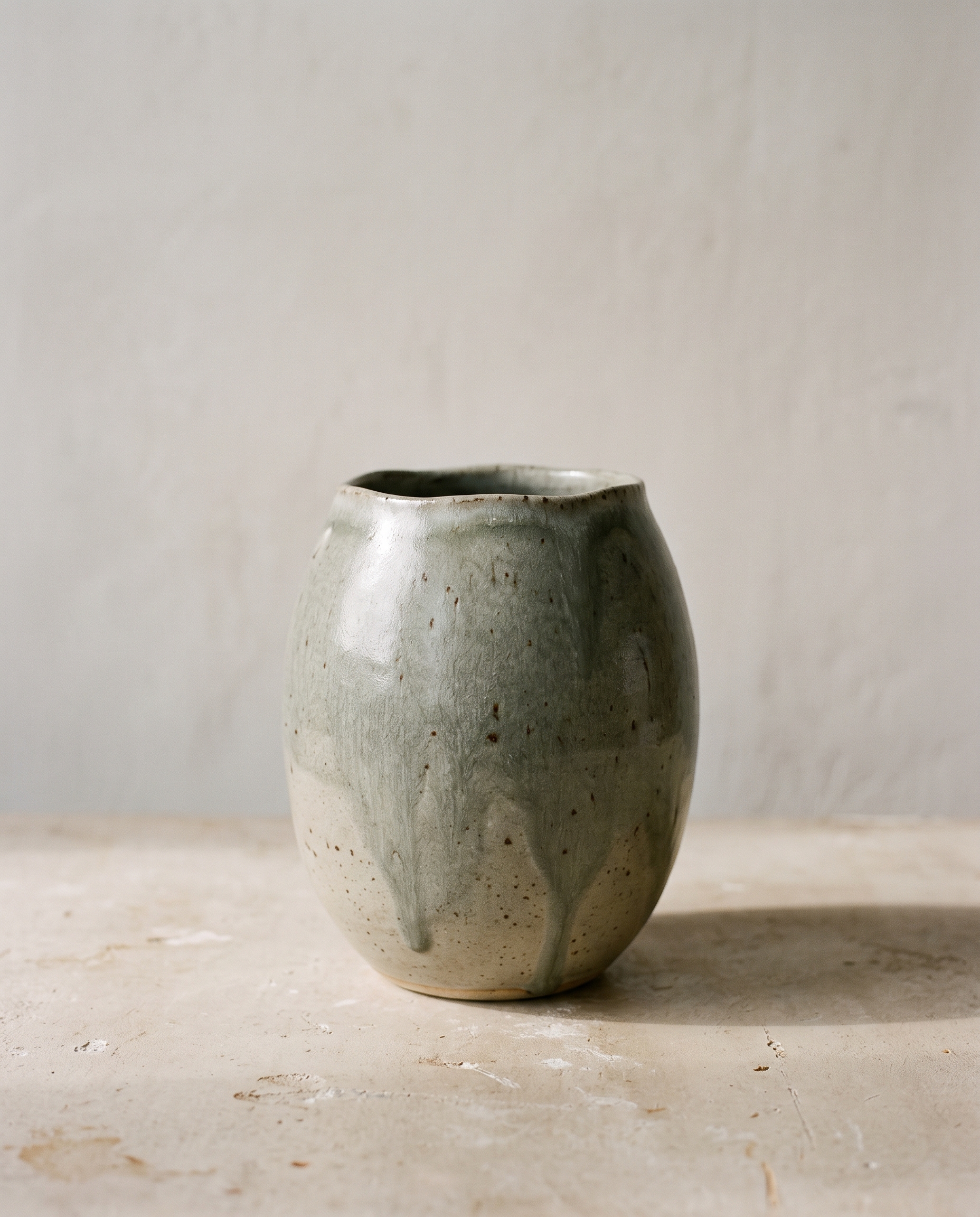
In Maya Laurent’s ceramics, the ash glaze is allowed to do what it will, pooling grey-green in the hollows, breaking pale at the rim, catching iron in fine dark flecks. Each vessel is a record of a single firing that cannot be repeated. ‘Vessel (Ash Glaze) No. 7’ is not the seventh attempt at one thing; it is the seventh of seven different things.
Collectors of ceramics learn a particular patience. A wood-fired jar by a maker like Fujimoto Ken, ash on one face, dark iron on the other, a lick of orange where the flame passed, is prized precisely for what the maker did not decide. The hand throws the form; the fire finishes it.
To live with such a piece is to keep company with a small, permanent uncertainty, a surface that will look slightly different in every light, forever. In an archive of considered things, it is the one that was, in the end, left to chance.